
Supporting ADHD Students: Tips for Focus and Break Management
Ask most ADHD students what takes the longest and they won’t say “the material.” They’ll say starting. Or staying focused. An assignment that should take 20 minutes can stretch across hours. This isn’t because it’s hard, but because the brain keeps stalling out.

This isn’t a motivation problem. ADHD brains are wired for deep focus on the right task at the right time, but getting started and sustaining attention on schoolwork requires different strategies than what works for many neurotypical students. The good news? Once you understand what’s happening, there are practical ways to work with your brain instead of against it.
How can you start?
One of the most effective strategies for getting started is deceptively simple: set a 2-minute timer. That’s it. Just two minutes.
The brilliance of this approach is that it lowers the mental barrier to beginning. Anyone can do anything for two minutes. You’re not committing to finishing the entire assignment or even working for a “reasonable” amount of time. You’re committing to two minutes. Once you’ve gotten yourself going for those two minutes, momentum takes over and you can often keep going much longer than you expected.
This is one of the foundational focus strategies for students with ADHD because it sidesteps the executive function challenge of task initiation. You’re not forcing yourself to start something that feels overwhelming. You’re just starting something small.
How can you keep going?
Starting is one challenge. Sustaining focus is another.
Unlike the difficulty of getting started, which hits you right at the beginning, the inability to keep going creeps up slowly. You’re working, you’re making progress, and then gradually it gets harder to concentrate. Before you know it, you’ve read the same paragraph three times and retained nothing.
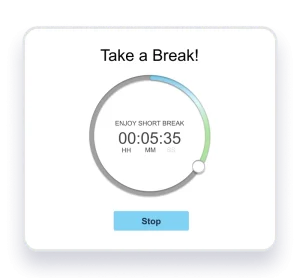
This is where timed work and break intervals become essential for helping ADHD students finish homework. The strategy works like this: once you’re working, set a timer for a manageable chunk of focused time (start with 10-15 minutes if you’re not sure what works for you). When the timer goes off, take a short break of 2-5 minutes. Then get back to work.
The break isn’t a reward for good behavior. It’s a tool for maintaining focus. ADHD brains need more frequent mental rest and giving yourself structured, guilt-free breaks prevents the cognitive exhaustion that leads to task abandonment. You’re not quitting; you’re resetting so you can keep going.
If you find that a timer interval feels too long or too short, try a different option that better matches your rhythm. And if none of the preset intervals feel quite right, reach out to hello@osagelearning.com with a suggestion, we’re always listening to what students need. The goal is to find a rhythm that matches how your brain functions, not to force yourself into someone else’s ideal.
Combined type?
No problem. Use both strategies together.
Set a 2-minute timer to get yourself started. Once you’re in motion, switch to a longer work timer with structured breaks. Be flexible with timer lengths based on what you need in the moment – some assignments might need shorter bursts, others might allow longer stretches once you hit your stride.
This combined approach is especially helpful for ADHD homework help because it addresses both the initiation challenge and the sustained attention challenge in one system. You’re not choosing between strategies, you’re layering them.
Timer Anxiety
Here’s the problem nobody talks about: timers can create as much stress as they solve.
If you’ve ever felt your chest tighten watching a countdown clock, you know what timer anxiety feels like. It’s the pressure of knowing you have to accomplish something before time runs out. For students who already associate timed tasks with stress such as timed math tests, impossible gym challenges, the countdown to a deadline, adding a work break timer for ADHD can feel like adding more pressure instead of relief.
The anxiety comes from the visibility of the timer itself. When you can watch the seconds tick by, when there’s a countdown constantly reminding you that time is running out, part of your brain is monitoring how much time is left instead of focusing on the work. It’s a distraction disguised as a productivity tool.

The Solution
This is exactly why Osage Learning built a timer that stays hidden until you need it.
Our work-break timer runs in the background during your study session – no countdown clock, no constant reminder of time slipping away. For the last minute of your work interval, a countdown appears in the upper right corner of the page so you know to finish your sentence or wrap up your thought. Then the screen dims, your break timer starts, and when break time is over, the work timer automatically starts again.
The system balances two competing needs: reducing ADHD homework timer anxiety by hiding the countdown, while still giving you enough warning to avoid being jarred out of focus mid-thought. Students can customize their work and break intervals in the settings menu, and the timer is available to everyone, not just students with ADHD diagnoses.
Because here’s the thing: these strategies work. They’re grounded in how attention and executive function actually operate. And when you pair practical techniques with tools designed to support them, homework stops feeling like an impossible battle and starts feeling manageable.